
Author:: Benny Barak
Published on:: 08 October, 2025
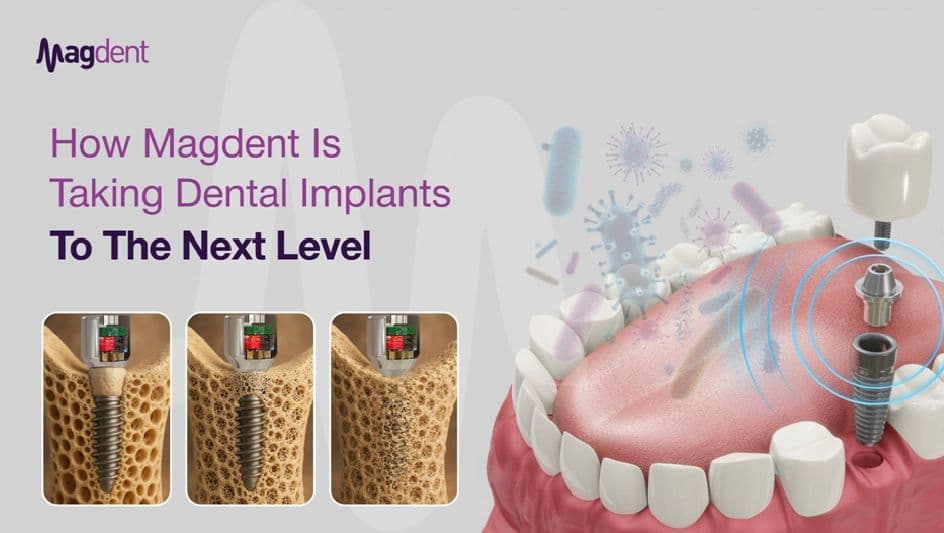
For decades, dental implants have been the gold standard for replacing missing teeth: reliable, long-lasting, and trusted by clinicians worldwide. But like every field in medicine, innovation continues to push boundaries.
One company leading that progress is Magdent. We are the pioneer behind a miniaturized electromagnetic device (MED) that brings pulsed electromagnetic field (PEMF) therapy directly into dental implants.
Rather than replacing traditional implants, Magdent enhances them, helping them heal faster, and solve complications that once limited outcomes. It’s a technological upgrade that adds new biological acceleration to a treatment already trusted by millions.
This technology doesn’t change what implants are; it changes how well they heal and perform, particularly during the most critical healing phase – the first month.
Traditionally, months go by before the implant is fully secure and ready to support a crown. But PEMF is rewriting that waiting period. By working in harmony with existing implant systems, Magdent expands the range of patients who can benefit, even those once considered challenging cases.
Recent studies show that when implants are paired with Magdent’s miniaturized electromagnetic device (MED), the bone integrates with the implant far more quickly. Patients can often move toward loading earlier, cutting down their treatment timeline without sacrificing safety [1]. Another trial highlighted stronger stability within just 30 days in areas that normally take longer to heal, like the upper jaw[2].
For patients, this translates to something simple but powerful: getting their smile back faster. For dentists, it means more predictable treatment schedules. Everyone wins.
Not every patient walks into a clinic with perfect bone quality. Age, extractions, or natural bone density variations often create hurdles. Traditionally, these factors could complicate implant success, or in some cases, prevent treatment altogether.
This is where Magdent’s PEMF shows its true strength. Research has found that implants exposed to PEMF develop denser bone-to-implant contact, even in areas of low bone density [3]. In other words, patients who might once have been told, “implants may not work for you,” now have a better chance at successful outcomes [2].
It’s a shift that widens the door for treatment, making implants more inclusive and less dependent on perfect conditions. This added layer of protection complements, not replaces, standard implant protocols, giving clinicians an additional, science-backed advantage in managing peri-implant health.
Ask any implant specialist, and they’ll tell you the same: one of the biggest concerns isn’t the implant itself, it’s the bacteria that can accumulate around it. Peri-implantitis, a condition where infection undermines the surrounding tissue and bone, is a leading reason implants sometimes fail.
PEMF offers a proactive layer of protection. Lab studies have shown it reduces harmful bacteria like P. gingivalis, which is commonly linked to gum disease [4]. Even more promising, Magdent’s PEMF seems to encourage a healthier overall balance in the oral microbiome, helping keep inflammation-causing bacteria at bay [5].
Its triple action: antimicrobial, anti-inflammatory, and bone-regenerative. It means PEMF isn’t just about healing faster; it’s about preventing problems before they even start [6] [7]. That’s a level of reassurance both patients and clinicians can appreciate.
Traditional implants work best when conditions are favorable. But what about patients already facing inflammation or bone loss? Historically, these cases often required additional surgery or antibiotics. Now, PEMF is offering a less invasive path forward.
Recent research shows PEMF doesn’t just stop damage; it actively promotes regeneration. By influencing the body’s own cellular signals, PEMF reduces destructive bone resorption while encouraging new bone growth, even in inflammatory environments (Source 8). In one study, stem cells exposed to PEMF expressed stronger markers of bone formation, even under stress [9].
And our real-world clinical data backs this up. Patients treated with PEMF therapy for peri-implantitis saw long lasting improvements in gum health, bone levels, and bleeding scores, benefits that held up even after a year or two [10].
This isn’t about replacing traditional techniques; it’s about adding a layer of regenerative support that helps patients keep their implants for life.
Dental implants remain the cornerstone of modern tooth replacement. But innovations like Magdent’s PEMF technology are redefining what they can achieve. Thereby, making healing faster, integration stronger, and outcomes more predictable. They’ve set the foundation, proving that replacing teeth with something strong, stable, and natural-looking is possible. But as PEMF technology continues to prove itself, the definition of what an implant can deliver is changing.
Instead of months of waiting, patients are seeing faster results. Instead of being turned away due to bone limitations, more people are becoming candidates. Instead of worrying about infection, patients have built-in protection. And instead of invasive interventions for peri-implant disease, there’s a regenerative, non-invasive option.
In short, the next generation of implants isn’t just about filling a gap. It’s about smarter healing, stronger outcomes, and a future where patients enjoy both confidence and peace of mind. Magdent’s MED device is at the center of this shift, showing us that the implants of tomorrow are already here today.
Sources:
[1] J Craniofac Surg. 2019 Jun;30(4):1055–1057. doi:10.1097/SCS.0000000000004763
[2] Materials (Basel). 2020 Apr;13(7):1667. doi:10.3390/ma13071667
[3] Clin Oral Implants Res. 2016 Aug;27(8):935–942. doi:10.1111/clr.12661
[4] Biofouling. 2020;36(8):923–934. doi:10.1080/08927014.2020.1825694
[5] npj Biofilms Microbiomes. 2025;11(36). https://doi.org/10.1038/s41522-025-00667-0
[6] Periodontol 2000. 2025;89(1):278–298. doi:10.1111/prd.12506
[7] Periodontol 2000. 2025;89(1):299–317. doi:10.1111/prd.12507
[8] Int J Nanomedicine. 2024;19:8695–8707. doi:10.2147/IJN.S470901
[9] Sci Rep. 2018;8:9017. https://doi.org/10.1038/s41598-018-27452-3
[10] EuroPerio11. 2025. Poster Presentation – Long-Term Effects of Focused PEMF Therapy on Peri-Implantitis (Multicenter Trial).
Subscribe to our newsletter to stay up to date on Magdent’s latest developments and news.
Let us know how we can support. We're here to provide support and answers to your clinical or technical questions.

